

Driver's License Photo—Rules & How to Take a Good One


- Fast
- 800K+
- Preview & Check
- Checked Photos
How to Prepare for Your DMV Photo: Rules That Actually Matter
- GOOD DRIVER'S LICENSE PHOTO
The DMV takes one photo. The card keeps it for years. Retakes cost money and a second trip. What’s below is the shortest path through the rules that actually get enforced — verified against state DMV sources.
Driver’s License Photo Rules — Quick Answer
Wear a solid medium color — blue, green, teal, burgundy.
Never white; it blends into the DMV backdrop.
Skip solid black, logos, patterns, and high collars.
Keep a closed-mouth or slight natural smile; a wide toothy grin can get you re-posed because it interferes with facial-recognition matching.
Take off hats, headbands, and sunglasses — head coverings are allowed for religious or medical reasons only.
Keep prescription glasses on unless staff ask you to remove them for glare.
And don’t look up at the camera until your hair, chin, and expression are set: the clerk won’t fire the shutter until your eyes are up.
What should you wear for a driver’s license photo?
The advice here is unusually consistent across state agencies and photographers, which makes it easy to act on:
Do
Do Why Solid medium tones — blue, navy, green, teal, burgundy, muted pink They separate you from the light backdrop and hold up in a low-contrast render A simple crew neck, collared shirt, or blouse The frame is taken from the chest or neck up, so this is all that shows One layer you’re comfortable in Coats, scarves, and hats come off before the camera anyway Don’t
Don’t Why White It blends into the DMV’s light backdrop and makes fair skin look washed out Solid black It flattens into a dark mass and drains color from pale skin Logos, slogans, busy patterns They pull attention off your face and can render as noise Turtlenecks and high collars They visually thicken the neck and crowd the jaw Anything strapless or off-shoulder In a head-and-shoulders crop it can read as no clothing at all One practical note that saves people a lot of worry: the photo is cropped from roughly the chest up. Whatever you’re wearing below that does not matter.
Unsure between two tops? Take a mirror selfie in each, run them through the preview tool on this page, and pick the one that still separates from a light backdrop in a head-and-shoulders crop.
Can you smile in a driver’s license photo?
This is the most contradicted question in the entire topic, and the confusion is real rather than invented. An Oregon DMV employee told The Oregonian that “a lot of people think they can’t smile. But it makes you look 100 times better.” New Jersey’s MVC says you may smile “but in a natural way” — explicitly not an “I just won $5 million in the lottery smile” — while the New Jersey State Police digital-photo standard demands “no smiling or frowning, mouth closed.” New Jersey had to circulate a memo to its own offices because staff were answering inconsistently.
The answer that holds everywhere: a closed-mouth or slight, natural smile is safe in every state. A wide, toothy grin is not — not because anyone objects to you looking happy, but because it distorts the geometry of the mouth and cheeks that facial-recognition software measures. States that run automated matching against their photo databases are the ones most likely to ask you to reset your face.
Practice it before you go. Nervous people either freeze into a grimace or overcorrect into a grin. Look at your phone’s camera, try a closed-mouth smile, then a slight open one, and pick the one you can reproduce on cue.
Better: take both versions on your phone, crop them in the tool, and choose the expression you can hold for three seconds without looking tense.
Can you wear a headband, hat, or hijab in a driver’s license photo?
Head coverings are allowed for religious or medical reasons only, and your full face must stay visible — New Jersey’s MVC defines the required frame as everything “from the top of your forehead to the bottom of your chin.” Virginia’s policy lists caps, hats, and turbans as permissible on religious or medical grounds and nothing else.
Everything else comes off:
- Headbands — including thin fabric or sport bands. Take it off; it counts as headwear.
- Hats and caps — off, no exceptions outside the religious/medical rule.
- Hoods — down. Wear the hoodie if you like, but the hood goes back.
- Bandanas and hair wraps — off unless worn for religious or medical reasons.
- Claw clips and hair ties — fine. They hold hair, they don’t cover your head.
- Hijab, turban, veil, kippah — permitted. Virginia explicitly allows a veil “adjusted to allow a full-faced photograph.” In New Jersey, tell staff at the camera station.
- Wigs and hairpieces — allowed if you wear them day to day. Virginia counts a wig as a “disguise” when it’s clearly used to alter your appearance.
- Medical head coverings — permitted; bring documentation if you have it, and expect to be asked.
Should you wear glasses in your driver’s license photo?
Sunglasses, tinted lenses, and photochromic (transition) lenses are prohibited in every state — Virginia lists sunglasses outright as a disguise. Ordinary prescription glasses are a different matter, and the widespread claim that they’re banned under REAL ID is false. New York’s regulation (15 NYCRR § 3.8) prohibits only “dark eye glasses.” The California DMV’s own spokesperson stated that “wearing glasses for the photo is optional.” Illinois’s administrative code says “prescription glasses may be allowed.” New Jersey’s photo standard shows a “with glasses” example among the acceptable ones.
The conditions are what matters: both pupils and irises must be visible, frames must not cross your eyes, and there must be no reflection on the lenses. Because DMV lighting is harsh and glare is common, staff often ask you to remove your glasses anyway, and AAMVA’s own best-practice guidance recommends it. Expect the request, don’t be thrown by it, and if you have a corrective-lens restriction on your license, keep them on unless you’re told otherwise.
One rule people miss: skip color-changing contact lenses. Your license states your eye color, and a mismatch is an argument you don’t want at a traffic stop.
What makeup works for a DMV photo?
DMV cameras use direct flash, which is why makeup that looks correct in your bathroom mirror fails on the card. Three specifics:
- Matte or satin finishes only. Shimmer, gloss, and highlighter bounce the flash and blow out as bright patches.
- Skip sheer concealer. It photographs patchy under flash even when it looks seamless in daylight.
- Match your foundation, or go one shade darker. Flash lightens skin by a stop or more.
Add a little blush — flash drains color and makes people look ill. And keep it close to your everyday face. Heavy contouring and dramatic eyes change the features an officer or a bartender will be comparing you against on your no-makeup days.
The three minutes that actually decide the driver’s license photo
Wardrobe is the easy part. Most bad license photos are lost at the counter, and none of the big guides cover this.
1Don’t look up until you’re ready. The clerk won’t press the button while your eyes are down. Keep your head lowered, fix your hair, set your jaw and your expression, breathe out — then look up. One photographer’s account of ignoring this is instructive: she was photographed mid-shoelace-tie, “half bent over, with a dopey look of shock.”
2Check the camera height. DMV cameras often sit well below adult eye level — one tall man measured his at roughly two feet low, which is exactly how you get an unflattering up-the-nose angle. If the lens is low, don’t raise your chin to meet it. Lower yourself instead: bend slightly at the knees so your eyes come level with the lens.
3Chin level, shoulders down, back straight. Not tilted up, not tucked in. Lengthen the back of your neck rather than pushing your chin forward.
4Eyes open, not forced. If you have allergies or a late night behind you, bring eye drops. Redness reads badly in a high-contrast image.
5Go off-peak. Mid-morning midweek, or a smaller-town office. A clerk who isn’t fighting a queue will give you the extra five seconds. Being pleasant helps more than you’d think.
6Arrive early, not on time. Turning up late can put you back at the end of the line, and rushing means sweating, flushing, and a photo you’ll pay to replace.
One rehearsal that actually transfers. The three minutes at the counter go faster than you think. Spend two minutes at home first: upload a phone shot, try the chin-level and closed-mouth smile you plan to use, and confirm the crop still looks like you. When you sit down, you’re repeating a pose you’ve already chosen — not inventing one under fluorescent lights.
Why does your DMV photo look worse than every other photo of you?
Because it isn’t really a photograph on the card. Modern licenses use grayscale portraits laser-engraved into polycarbonate rather than printed color images — Virginia’s DMV says this makes forgery “all-but impossible,” and Hawai’i’s redesigned card, rolling out in July 2026 with 50 new security features, switched to “laser-engraved black-and-white photos, rather than printed color photos.”
Grayscale is unforgiving in specific, predictable ways, and knowing them changes what you do:
- Color contrast disappears. A navy shirt and a black shirt become the same dark shape. What survives is contrast in brightness — which is exactly why medium tones beat both white and black.
- Shadows deepen. Under-eye circles, nasolabial folds, and jaw shadows all read a stop darker than they look in color. Good posture and a level chin do more here than makeup.
- Texture amplifies. Shine on the forehead and nose becomes a white blob. Blot before you sit down.
- Resolution is low. Fine detail is lost, broad shapes survive. This is why a simple neckline and a clean, symmetric hairline photograph well and fussy detail doesn’t.
Can you retake your driver’s license photo?
Yes, in most states — but almost never remotely, and rarely for free. New York states it flatly: “You must go to a DMV office to change your photo.” The standard process:
1Check whether a renewal is close. If you’re due within the next few months, wait and take the new photo at renewal — that’s free in most states. New York charges nothing extra to update your photo during a renewal.
2Book an in-person appointment. A photo change is not an online transaction anywhere we could verify. Virginia lists “you need a new photo” as an explicit disqualifier for its online replacement service. Texas is appointment-only with slots bookable up to six months out; California opens appointments 90 days ahead.
3Bring the form, your current card, and payment. In New York that’s form MV-44, your existing license (which you surrender), and $17.50. Other states process it as a duplicate or replacement.
4Expect the card by mail. Usually 1–4 weeks. You normally keep driving on a temporary document or your old card in the meantime.
What it costs. Retake and duplicate fees run from roughly $5 to just over $40 depending on the state — New York is $17.50 to change a photo, California charges $37 for a duplicate (or $46 to renew outright and get a new photo with a new expiry). Fees change without notice; confirm yours on your own DMV’s fee page before you go.
One thing worth knowing before you pay. If your license is close to expiring, renewing is often the better transaction: similar cost, new photo, new term. If it isn’t, ask your DMV whether a photo change is processed as an amendment or a duplicate — the difference can be $20.
Can you take your own driver’s license photo at home?
Almost never — and you should be skeptical of any tool that says otherwise. One AI-generated page claims “29 US states now allow online driver’s license photo uploads.” We could not verify that against a single official source, and state pages say the opposite: online renewal reuses the image already on file. South Carolina: “The SCDMV will use your current photograph and signature.” Virginia will “use the photograph on your existing credential” and requires an appointment for a new one. Oregon requires a photo on file less than nine years old.
There are narrow, documented exceptions where you must supply your own photo:
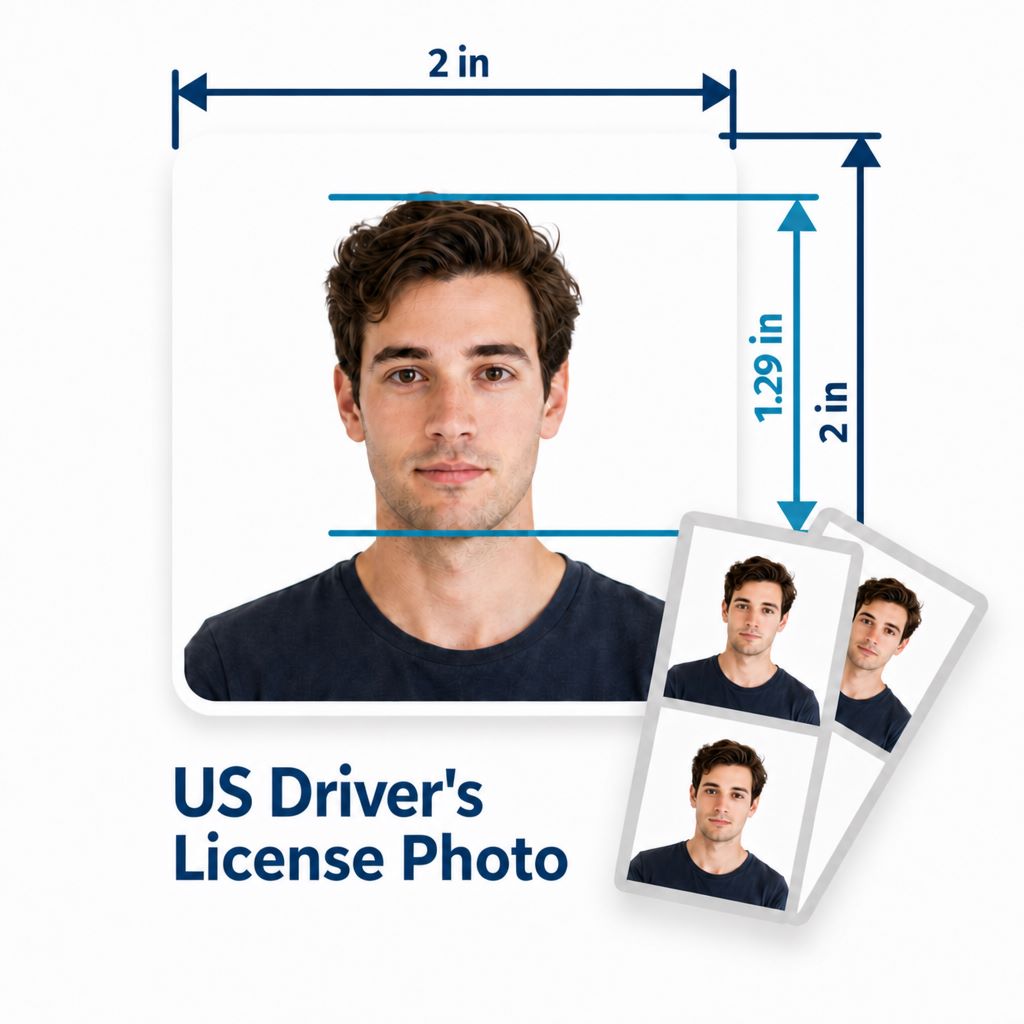
- Texas DPS renewal while out of state (by mail) — explicitly requires “a 2×2 passport-style photo.”
- Ohio BMV out-of-state military and dependent renewals — same 2×2 passport-style requirement.
- International Driving Permits (AAA / AATA) — always your own photo: two identical 2×2 color prints, signed on the back, taken within the last six months.
If you are in one of those lanes, our tool produces exactly that file. If you are not, no service can put your own photo on your license — and the honest use for a tool like ours is different: rehearsing. Upload a phone shot, see how your top, hair, and expression read in a cropped ID frame, and walk into the DMV already knowing what works.
State-by-state: what genuinely differs
The federal REAL ID standard sets the floor. Everything above it is the state’s call, which is why you can get two confident, opposite answers from two clerks. Verified examples:
- Virginia — the strictest published stance on appearance. DMV “reserves the right to refuse to issue” a card to anyone appearing “in a disguise or who intentionally distorts their face.” Disguise “includes, but is not limited to, unusual makeup, paint, wig, sunglasses or false facial hair.” Distortion includes “deliberately crossing or squinting eyes, or opening or twisting mouth.”
- New Jersey — full face required “from the top of your forehead to the bottom of your chin”; a natural smile is allowed, a lottery-win grin is not; and MVC offers a photo extension for people undergoing medical treatment that has changed their appearance.
- New York — clear prescription glasses fine, “dark eye glasses” prohibited; photo changes in person only, $17.50 outside a renewal.
- California — glasses optional per DMV; duplicate $37, renewal $46.
- Illinois — “prescription glasses may be allowed”; the photo must be refreshed at least every 12 years for a license, 15 for an ID card.
- Florida — 8-year cycle, in person every other cycle, and in person regardless if the photo on file is over 12 years old.
Under federal REAL ID rules you must appear in person and be re-photographed at least every other cycle, whatever your state’s other rules say. If your appearance has changed a lot — weight, transition, medical treatment, a name change — say so at the counter rather than hoping nobody notices; that’s what the photo-extension and appearance-change procedures exist for.
Your driver’s license photo now lives on your phone too
As of July 2026, Apple Wallet IDs are live in 14 states plus Puerto Rico, and roughly 20 states offer some form of mobile driver’s license. mDL photos generally reuse the image from your physical card, so one good photo covers both. The practical consequence: the picture you’re about to take will also be the one that appears full-screen on your phone at a traffic stop or a checkpoint — bigger and brighter than it ever was on the card.
Where is a driver’s license photo taken?
If you are in one of those lanes, use our tool: it crops and sizes a phone photo to the 2×2 passport-style file Texas, Ohio, and IDP issuers ask for — or we redo it free if the framing is off.
If you are not, no service can put your own photo on your license. The honest use for a tool like ours is different: rehearse. Upload a phone shot, see how your top, hair, and expression read in a cropped ID frame, and walk into the DMV already knowing what works.
How to preview a driver’s license photo online (and when you actually need a file)
1Decide which lane you’re in. Normal DMV visit → rehearsal only. Texas/Ohio mail renewal or IDP → you need a 2×2 photo.
2Upload a recent phone photo — chest-up, face clear, no filter.
3Check the crop: solid medium top, full face, expression you can hold.
4If rehearsing — note what worked, close the tab, go to your appointment. If you need the file — download the 2×2 digital and follow your state’s or AAA/AATA instructions.
This guide covers U.S. driver’s license photo rules for 2026 — what to wear, smiling, headwear, glasses, retakes, and how requirements differ by state. It also explains where photos are taken, when you need your own 2×2 photo (Texas/Ohio mail renewal, IDP), and how to preview a license-style crop online before your DMV visit.
Written by: PhotoBooth Online Editorial Team
Last updated and reviewed: August 2026
Sources: Virginia DMV — Policy on License/ID Photographs; DHS — REAL ID
Fee data verified August 2026. State fees change without notice — confirm with your DMV.
How to preview a driver's license photo online (and when you actually need a file)
1.
2.
3.
4.
How to Get Drivers License Photos Online?
- STEP 1Upload/Take Photo
- STEP 2Download Ready Photo


Drivers License Pictures: 6 Clear Benefits of PhotoBooth Online
DIY at Home
Prepare a good photo whenever is convenient for you! With our driver license editor, you can do it anywhere–at home or at work.Photo Auto-Adjustment
Even if you upload full size photo of yourself at the party, you will get your image cropped and adjusted to the right specs.Digital Copy
You have a digital file of your photo always with you. Use PhotoBooth Online if you need to retake your photo for driver’s license.Quick Drivers License Photo Edit
Have a license photo you love but it is of the wrong size or background? No problem! In an instant, PhotoBooth Online will edit your image as per specs.Online Photo Preview
Check your license photo immediately after taking it. Make sure your picture is pixel-perfect.Best Driving License Photos
See how your hair, makeup, and face look like on a mugshot. Wear different clothes, change your hair style, do makeup and try numerous shots.
Frequently Asked Questions
Can you retake your driver's license photo?
Yes, in nearly every state — but you have to go to an office in person, and it usually costs money. New York’s DMV is explicit: “You must go to a DMV office to change your photo.” Bring the state’s application form, your current card (you’ll surrender it), and the fee — $17.50 in New York outside a renewal. If your license is due to expire soon, wait and take the new photo at renewal, which is normally free.
Can I wear a headband in my driver's license photo?
No, headbands count as headwear, and headwear is allowed for religious or medical reasons only. Take it off before you sit down. Claw clips, hair ties, and pins are fine — they hold hair back without covering your head. Hijabs, turbans, veils, and kippahs are permitted; your full face from forehead to chin must stay visible.
What is the best color to wear for a driver's license photo?
A solid medium tone: blue, navy, green, teal, burgundy, or a muted pink. Avoid white — it blends into the DMV’s light backdrop — and avoid solid black, which flattens out and drains color from pale skin. Skip logos, slogans, and busy patterns. Only your chest up appears in the frame.
Can you smile in a driver's license photo?
A closed-mouth or slight natural smile is accepted in every state. A wide toothy grin is not reliably accepted, because it distorts the mouth and cheek geometry that facial-recognition software measures — New Jersey’s MVC allows a natural smile but not an “I just won $5 million in the lottery smile.” Practice a closed-mouth smile before you go so you can reproduce it on cue.
What are the requirements for a driver's license photo?
Face the camera straight on with your whole face visible from the top of your forehead to the bottom of your chin. Neutral expression or a slight closed-mouth smile. No hats, headbands, or sunglasses; religious and medical head coverings are permitted. No tinted or photochromic lenses, and no glare on prescription glasses. Nothing that distorts your face — Virginia can refuse to issue a card to anyone who squints, crosses their eyes, or twists their mouth deliberately. Individual states add their own rules, so check yours.
How do you retake a driver's license photo?
You can get a new license photo in three situations: when you renew your license, when you replace a lost, damaged, or stolen card, and when you specifically request a photo change at a licensing office for a fee. The third route requires an in-person appointment, the state’s application form, and surrender of your current card — New York charges $17.50 for it. Allow one to four weeks for the new card to arrive by mail.
Can you wear glasses in a driver's license photo?
Usually yes. Only dark, tinted, and photochromic lenses are universally banned — New York’s regulation prohibits “dark eye glasses” specifically, and the California DMV calls clear glasses “optional.” Both eyes must be fully visible with no glare and no frames crossing the eyes, so staff may still ask you to remove them. If your license carries a corrective-lens restriction, wear them unless you’re told otherwise.
Can you wear a hat in your driver's license photo?
No, unless you wear it for religious or medical reasons and your full face stays visible. Virginia’s policy permits caps, hats, and turbans on those grounds only. Hoods must come down.
How much does it cost to retake a driver's license photo?
It depends on the state, and ranges from about $5 to just over $40. New York charges $17.50 to change a photo outside a renewal; California issues a duplicate for $37, or $46 for a full renewal with a new expiry date. During a scheduled renewal, the new photo is normally included at no extra cost. Fees change often — confirm on your own DMV’s fee page.
Is a driver's license a government-issued photo ID?
Yes, a driver’s license issued by a state DMV, DPS, or DOL is a government-issued photo identification document. Since May 7, 2025, federal agencies including TSA accept it for domestic flights and access to federal facilities only if it is REAL ID–compliant, which is marked by a star on the front of the card.
Can the DMV refuse to take your photo?
Yes, Virginia’s DMV “reserves the right to refuse to issue a driver’s license or identification card to any applicant that appears for photographing in a disguise” — which it defines as including unusual makeup, paint, wigs, sunglasses, and false facial hair — “or who intentionally distorts their face” by crossing or squinting the eyes or twisting the mouth. Show up looking like yourself and you will not have a problem.
What makeup should you wear for a driver's license photo?
Matte or satin finishes only — shimmer, gloss, and highlighter reflect the DMV’s flash and blow out as bright patches. Skip sheer concealer, which photographs patchy under flash. Match your foundation to your skin or go one shade darker, since flash lightens the face, and add a little blush. Keep it close to your everyday look so the card still resembles you without makeup.
Related Topics